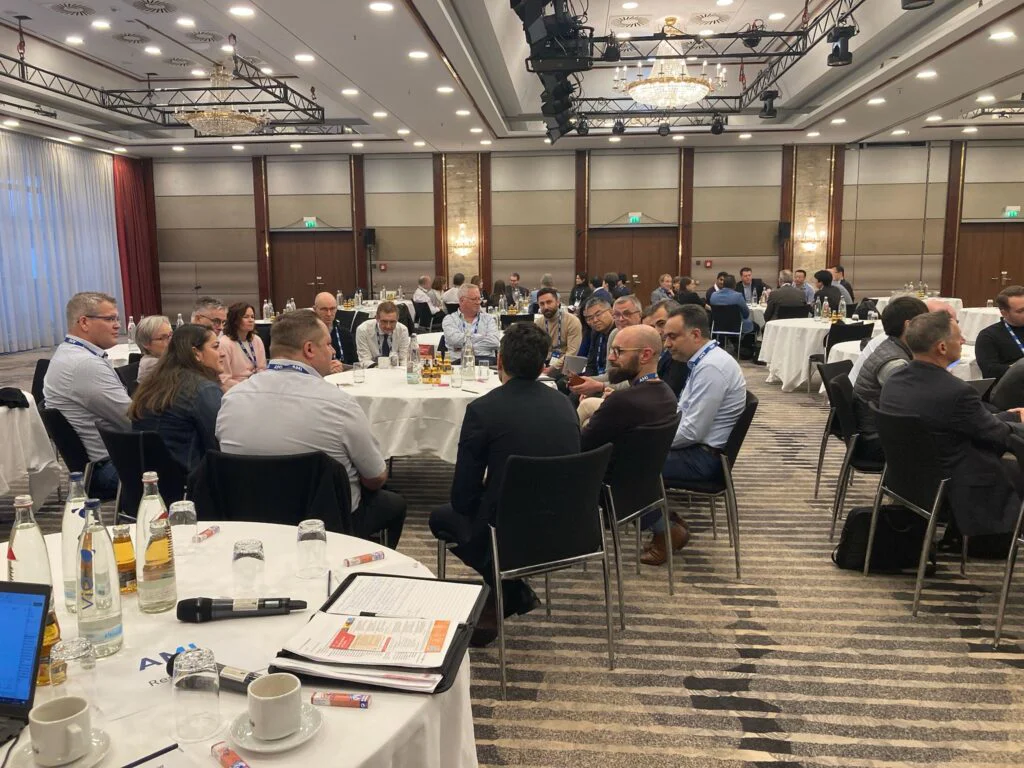
Round tables
Round table discussions between participants were organised on the following themes: Emerging PFAS restrictions and how it will affect FR, Commercialisation of FRs in Europe, Sustainability and recyclability strategies for FR manufacturers, Opportunities for FR products for electrification applications, Opportunities for FR products for commercial buildings and infrastructure.
Below we bring together some comments collated from some of the participant round table discussions, noted by participants, and not claiming to be exhaustive summaries.
- PFAS / PTFE anti-drip:
Moving away from PFAS anti-drip (PTFE, polytetrafluoroethylene, used to prevent flaming drips of molten polymer spreading fire). PTFE is also widely used as a polymer processing agent. Although it is today not at all clear which applications and which PFAS chemicals may be concerned by the announced EU PFAS restriction, nor when this might be enacted, many end-users and compounders are already asking for non-PFAS solutions. Today there is no “drop-in” replacement for TPFE, but different approaches and packages for different polymers. Higher prices and formulation costs will cease to be an obstacle if the EU restrictions effectively ban TPFE in some or all applications. Challenges are to develop a wider and more flexible tool box of solutions to avoid flaming dripping, the presence into the future of ‘legacy’ TPFE in recycled plastics (e.g. from use as a processing aid in packaging plastics) and how to avoid imports into the EU of articles (e.g. telephones or cars) or parts with PFAS-containing materials.
- Commercialisation of FRs in Europe:
There is clear need to develop new flame retardant solutions to meet fire safety requirements in new applications such as e-mobility. At present, the focus of development is on finding new synergistic combinations because commercialisation of new molecules is very difficult. AI can help identify potential synergistic combinations. Commercialisation of new molecules is difficult because users prefer globally registered materials, but such registrations are very expensive due to different data are needed in different jurisdictions, thus hindering FRs manufacturers from rolling-out new molecules globally. To facilitate the placing on the market of newly developed FRs molecules in Europe, participants suggested that a simplified temporary REACH authorisation should be possible for a limited business development period (beyond the current 1 tonne registration threshold), in order to test markets and benefits without engaging full registration costs.