PIN FRs for 3D-printing with natural fibres
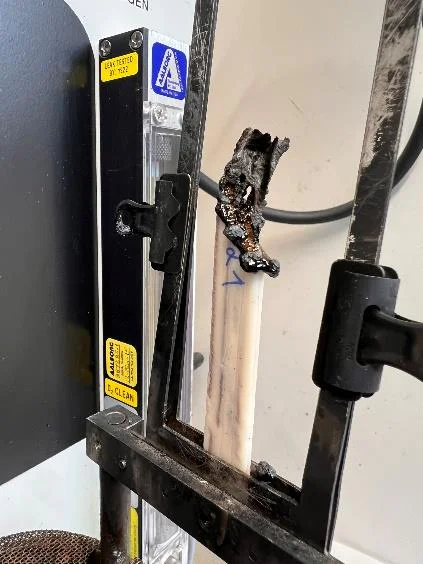
PIN flame retardants were successfully tested in innovative 3D-printing using continuous fibre/polymer yarns. Bio-based yarns (flax fibre, viscose – which is derived from cellulose) were co-extruded with PLA (polylactic acid) then tested in FFF (fused filament fabrication) 3D-printing (ATMAT Saturn 3D-printer). PIN FRs tested were, for the PLA polymer: ammonium polyphosphate (30% loading, APP microencapsulated in melamine) and for the fibres: ammonium sulphamidate, sulfamic acid and an Oekotex-accepted organosphosphorus-nitrogen PIN FR. The 3D-printed material achieved UL 94 V-0 (4 mm) with the PIN flame retardants and LOI up to 34% (limiting oxygen index). Peak heat release rate, determined using micro combustion calorimetry, was reduced by up to -50% compared to non-FR yarns. In the printed composites the main effect was due to the APP-rich PLA shell of the filaments. Future work is focused on increasing the fibre volume of the printed composites.
Photo: copyright Fraunhofer WKI.
“Flame-retardant treatments of continuous flax fibres and rayon rovings: a novel approach for 3D-printing applications”, A. Schirp et al., Polymer Degradation and Stability, vol? 243, Jan. 2026, 111746 https://doi.org/10.1016/j.polymdegradstab.2025.111746